
Dr. Ofir Degani’s Research Group
Dr. Ofir Degani completed his Ph.D. at the Technion-Israel Institute of Technology (Haifa, Israel), specializing in genetic engineering approaches in phytopathology. He carried out his post-doctoral studies at the Migal-Galilee Research Institute (Israel). Currently, Dr. Degani serves as the research group director of this institute’s Phytopathology and Crop Protection Laboratory and a senior staff member at Tel-Hai College (Israel). His research is based on molecular, biochemical, and microbial approaches for understanding and preventing plant fungal diseases. Specifically, his research group is working on (1) developing biological, chemical, and agrotechnical controls for plant diseases, including Maize late wilt and stalk rot, Cotton charcoal rot, and Onion basal rot. (2) Study and manipulate the plant microbiome to provide an eco-friendly toolkit to protect plants. (3) Investigating the interactions between pathogens and their role in plant pathology to improve crop protection.
Current ongoing research topics:
- Study the “plant disease triangle” - the combined influence of the host plant, the fungal pathogen, and the environment on plant diseases and crop protection.
- Chemical protection (using seed treatments, spraying, and dripline irrigation) of maize, cotton, onion, and other crops against fungal pathogens.
- Develop biological approaches to protect crops from soil diseases. This includes the use of biocontrol agents (fungi and bacteria), strengthening soil mycorrhizal networks (the soil microbiome), manipulating the plants’ natural endophytes (the plant microbiome), and enhancing the plants’ natural defense system.
- Investigate the interactions between phytopathogenic fungi and their combined influence on crops' disease burst and severity.
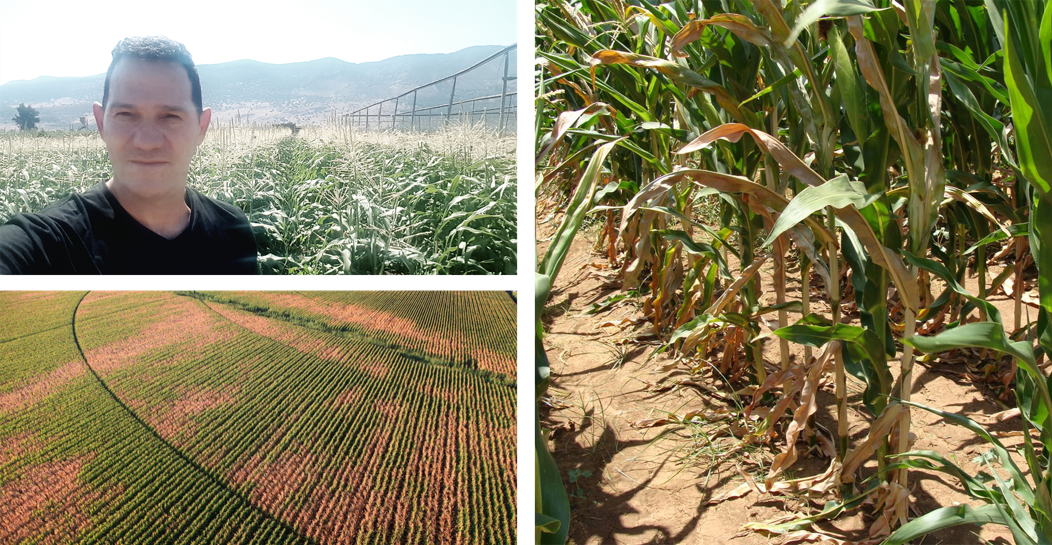
Research plan and challenges
The growing trend of reducing pesticides’ use raises the need for alternative ways of coping with severe fungal diseases such as the late wilt of maize. Hence, we propose developing two environmentally friendly strategies to control maize late wilt disease, for which we have gained positive preliminary results. First, maintaining the continuity of soil mycorrhizal fungi between seasons has proven to be an essential factor in various field crops. Still, it has not yet been tested against the late wilt pathogen in Israel. The potential of strengthening soil mycorrhizal networks against the soil fungal pathogen has only now started to be revealed. The unique case of late wilt disease and the encouraging preliminary results provide an excellent opening stage and opportunity to investigate this control method. In order to do this, we will be required to:
- Repeat and establish the results using a greenhouse pot experiment over a full growth period
- Identify the mycorrhizal fungi involved
- Examine ways of strengthening the desired soil mycorrhizal networks
- Extend the research to field experiments
Similarly, in recent years we have conducted research with a new Trichoderma spp. isolates and achieved promising results. Consequently, we propose using the effective Trichoderma spp. or their extract in order to prevent the penetration and establishment of the M. maydis pathogen at the early growth period of maize. Thus we suggest using the late wilt controlling agents – Trichoderma isolates – and developing application methods to implement them. This goal will require several steps:
- Identifying the active compound/s in the Trichoderma spp. extract
- Examining ways of enhancing the secretion of these ingredients
- Applying the Trichoderma spp. hyphae or the extract and examining it in sprouts (up to the age of 40 days) under controlled conditions in a growth chamber
- Examining the Trichoderma spp. (extract and hyphae) seed coating against direct application of the fungi or their section to the soil under field conditions over a full growth period
We are now specializing in two important and severe corp diseases: cotton charcoal rot, caused by Macrophomina phaseolina, and onion (Allium cepa) basal rot caused by Fusarium sp. The challenges of developing efficient and cost-effective strategies to reduce the diseases’ damages include:
- Study these pathogens and their interactions with the host, under different environmental conditions.
- Undersending the involvement of other fungal phytopathogens in the diseases’ outburst and damages.
- Develop a new research tool-kit to study those diseases.
- Search for new ways (chemical, biological, and agro-mechanical) to restrict those diseases’ harmful effects and prevent their spreading.
Education
Ph.D. 2005, Biology, Technion Institute of Technology, Israel
M.Sc. 2001, Biology, Technion Institute of Technology, Israel
Academic and research experience
- 2025 - Today – Head of the B.Sc. Biotechnology Department, Tel-Hai University of Kiryat Shmona and the Galilee (Israel).
- 2025 - Today – Chair of the Teaching Committee, B.Sc. Biotechnology Department, Tel-Hai University of Kiryat Shmona and the Galilee (Israel).
- 2025 – Faculty representative on the committee for establishing regulations at the future Tel-Hai University of Kiryat Shmona and the Galilee (Israel).
- 2024 - 2025 – Accompanying the IDF reserve servants' students on behalf of the Faculty of Sciences, Tel-Hai College.
- 2021 - 2022 – Chairman of the Committee for the Advancement of Online Laboratory Courses in collaboration with universities in Israel and abroad.
- 2007 - 2012 – Member of the pre-veterinary program leading committee.
- 2007 - 2008 – Member of the research committee of Ohalo College (Israel).
- 2007 – Led the master's degree program preparation at Ohalo College (Israel).
Representation in academic committees
- 2022 - 2026 – Israel's representative in the COST Action Management: CA21134 / Towards zer0 Pesticide AGRIculture: European Network for Sustainability (T0P-AGRI-Network), European Cooperation in Science & Technology. (Link).
Academic Editorial Positions
Editorial Board positions
Processed and finalized editorial decisions for about 170 manuscripts.
- 2024 - Today – Editorial Board member, Journal of Fungi. (Link).
- 2022 - Today – Associate Editor Board member, Frontiers in Fungal Biology, Fungi-Plant Interactions. (Link).
- 2022 - 2024 – Editorial Board member, Agrochemicals. (Link).
Academic Editing of Special Issue/Topic
- 2025 - Today – Academic Editor, Research Topic: "Insights into the Molecular Dynamics of Stress Physiology in Allium Crops." Frontiers in Plant Science (Link).
- 2025 - Today – Academic Editor, Special Issue: "Plant Fungal Diseases and Crop Protection 2nd Edition," Journal of Fungi. (Link).
- 2024 – Academic Editor, Special Issue: "Plant Fungal Diseases and Crop Protection," Journal of Fungi. (Link).
- 2023 - 2024 – Academic Editor, Special Issue: "Roles of Soil and Roots Biotic and Abiotic Conditions in Fungal-Plant Interactions and Plant Performance 3.0," Journal of Fungi. (Link).
- 2023 - 2025 – Academic Editor, Research Topic: "Plant-friendly microorganisms as a bio-barrier against pathogens," Frontiers in Fungal Biology, Fungi-Plant Interactions. (Link).
- 2021 - 2023 – Academic Editor, Special Issue: "Roles of Soil and Roots Biotic and Abiotic Conditions in Fungal-Plant Interactions and Plant Performance 2.0," Journal of Fungi. (Link).
- 2021 - 2022 – Academic Editor, Special Issue: "Interactions between Microorganisms in Plant Diseases," Agriculture. (Link).
- 2021 - 2022 – Academic Editor, Special Issue: "Roles of Soil and Roots Biotic and Abiotic Conditions in Fungal-Plant Interactions and Plant Performance," Journal of Fungi. (Link).
Reviewing scientific papers
Most reviews can be found on the Web of Science at:
https://www.webofscience.com/wos/author/record/F-3978-2014
18/08/2025 Plant Disease, 10/01/2025Plant Disease, 23/10/2024 Cereal Research Communications, 17/09/2024 Fungal Biology Reviews, 06/06/2024 Fungal Biology Reviews, 16/12/2023 BMC Plant Biology, 21/04/2023Plant Disease, 16/01/2023 Plant Pathogen Interaction. Springer, 24/11/2021 European Journal of Plant Pathology, 30/12/2020Microorganisms, 11/12/2020 Microorganisms, 3/09/2020Journal of Fungi, 06/08/2020 BMC Genomics, 12/06/2020 Plants, 13/05/2020 Journal of Fungi, 20/04/2019 – New Pest Response Guidelines. US Department of Agriculture, 31/03/2019 Plant Pathology, 10/03/2018 European Journal of Plant Pathology, 13/02/2015 Biocontrol Science and Technology, 29/09/2014 Phytopathology, 05/04/2014 Phytoparasitica.
Membership in scientific societies
- 2008 - Today (with a few years of non-membership in between) – Israel Phytopathology Society (IPS).
- 1999 - Today (with a few years of non-membership in between) – Israel Society for Microbiology (ISM).
- 2010, 2019, 2023 – Israel Scientific Society of Field Crops and Vegetables
- 2005, 2011, 2023 – Israel Societies for Experimental Biology - FISEB (ILANIT)
- 2022, 2025 – Israel Scientific Society of Science and the Environment
- 2019 – American Society for Microbiology (ASM).
- 2012 – Mediterranean Phytopathological Union
Other activity and service
- 2022 - 2023 – Leading the graduate students' program at the Tel-Hai Center of Science and Knowledge for Gifted and Excellent Children at Tel-Hai Academic College, Israel Ministry of Education, Division for Gifted and Outstanding Students (Israel).
- 2008 – 2021– Headmaster of the Tel-Hai Science and Knowledge Center for the Gifted and Talented Pupils, the Israel Ministry of Education, the Pedagogical Administration, the Division for the Gifted and Talented Pupils, Israel
- 2014 – 2017 – Head of the North Israel Group of Centers for Gifted and Talented Children, the Israel Ministry of Education, the Pedagogical Administration, the Division for the Gifted and Talented Pupils, Israel
Research Grants
Israeli grants awarded
* Activity or achievement since the last promotion
All listed grant amounts represent funds awarded directly to this document’s author unless otherwise specified. Related publications are cited by their number in the publications list.
Year | Funded by/ Amount | Topic | Co-Researcher | Role in Research |
2026 | Israel Plant Council, Ministry of Agriculture 18,000 NIS | Onion Seed Microbiome Endophytic Enrichment for Basal Rot Protection | Dr. Ofir Benjamin | * PI |
2026 | Israel Council for Cotton Production and Marketing Ltd. 70,000 NIS | Population structure of Macrophomina phaseolina in Israeli cotton and integrated biological–chemical control under field conditions. | Dr. Onn Rabinovitz Dr. Liat Avrahami Moyal | * PI |
2026 | Israel's Organization of Extensive Cultivation. 25,000 NIS | Establishment of pathogens in wheat and their impact on summer crops in the crop cycle – corn, cotton, and sesame. | Dr. Onn Rabinovitz Mr. Yoav Golan | * PI |
2025 | Israel Plant Council, Ministry of Agriculture 63,750 NIS (Partial share 5,000 NIS) | Examining the effectiveness of chemical and biological treatments for controlling the fungus Athelia rolfsii (Southern blight) and the earwig insect Euborellia annulipes in peanuts. | Dr. Meri Dafni-Yalin (PI) Dr. Roni Gafni Dr. Onn Rabinovitz Dr. Liora Shaltiel-Harpaz | * Co-PI |
2025 | Israel Council for Cotton Production and Marketing Ltd. 60,000 NIS | Development of an integrated management control for charcoal rot disease in cotton: a clay-based formula for the slow release of Azoxystrobin in the sowing strip and biological seed dressing. Publication: 3, 4 | Dr. Onn Rabinovitz | * PI |
2025 | Israel's Organization of Extensive Cultivation. 29,000 NIS | Development of an integrated management control for late wilt disease in corn: a clay-based formula for the slow release of Azoxystrobin in the sowing strip and biological seed dressing. Publication: 1, 3 | Dr. Onn Rabinovitz Mr. Yoav Golan | * PI |
2024-2025 | Israel Plant Council, Ministry of Agriculture 25,000 NIS | Development of an Eco-Friendly Interface Using Trichoderma spp. to Control Onion Basal Rot Disease Publication: 2 | Mr. Elyahu Margalit | * PI |
2024 | Israel Council for Cotton Production and Marketing Ltd. 70,000 NIS | Development of an eco-friendly pesticide interface, based on Trichoderma fungi, against the cause of cotton charcoal rot | Dr. Onn Rabinovitz Dr. Assaf Chen | * PI |
2023-2024 | Israel Plant Council, Ministry of Agriculture 28,000 NIS | Chemical control of Fusarium spp., the causal agents of onion (Allium cepa) basal rot Publications: 9 | Mr. Elyahu Margalit | * PI |
2023 | Israel Council for Cotton Production and Marketing Ltd. 50,000 NIS | Development of an eco-friendly pesticide interface, based on Trichoderma fungi, against the cause of cotton charcoal rot Publication: 10 | Dr. Onn Rabinovitz Dr. Assaf Chen | * PI |
2023 | Israel's Organization of Extensive Cultivation. 20,000 NIS | Biological enrichment of fodder corn seeds against the late wilt disease Publications: 8, 13 | Dr. Onn Rabinovitz Mr. Yoav Golan | * PI |
2023 | ICA Israel (Jewish Colonization Association) 25,000 $ | Developing an Azoxystrobin slow-release clay carrier for eco-friendly control of corn late wilt disease disease Publications: 1, 3 | Prof. Giora Rytwo | * PI |
2022 | Israel Council for Cotton Production and Marketing Ltd. 55,000 NIS | Development of an eco-friendly pesticide interface, based on Trichoderma fungi, against the cause of cotton charcoal rot Publications: 11, 13 | Dr. Onn Rabinovitz Dr. Assaf Chen | * PI |
2022 | Israel Plant Council, Fruit Branch, Ministry of Agriculture 7,000 NIS | Isolation and identification of apple fruits' fungal pathogens | Dr. Shaul Naschitz (PI) | * Co-PI |
2022 | Israel Plant Council, Ministry of Agriculture 17,000 NIS | Isolation and Identification of Fusarium spp., the causal agents of onion (Allium cepa) basal rot in northeastern Israel Publication: 9 | Mr. Shaul Graph Mr. Elyahu Margalit | * PI |
2022 | Israel's Organization of extensive cultivation 20,000 NIS | Combined biological-chemical pesticide to prevent late wilt in corn Publications: 14, 56 | Dr. Onn Rabinovitz | * PI |
2021 | Israel Plant Council, Ministry of Agriculture 18,000 NIS | Chemical control of Fusarium spp., the causal agents of onion (Allium cepa) basal rot Publications: 12, 16, 27 | Mr. Shaul Graph Mr. Elyahu Margalit | * PI |
2020 | Israel Plant Council, Ministry of Agriculture 10,500 NIS | Chemical control of Fusarium spp., the Causal Agents of Onion (Allium cepa) Basal Rot Publication: 16, 27 | Mr. Shaul Graph Mr. Elyahu Margalit | * PI |
2020 | Israel Council for Cotton Production and Marketing Ltd. 20,000 NIS | Biological control of Macrophomina phaseolina, the cotton charcoal rot disease causal agent Publications: 11, 13 |
| * PI |
2020 | ICA – Migal accelerator, Israel 100,000 NIS | Isolation and identification of active ingredient against Magnaporthiopsis maydis, the maize Late-wilt disease causal agent Publications: 18, 22, 56 | Prof. Soliman Khatib | * PI |
2019-2021 | Israel Ministry of Agriculture and Rural Development Chief Scientist 450,000 NIS (Partial share 82,000 NIS) | Using remote sensing tools for the early detection and prevention of soil-borne diseases in field crops while reducing the amounts of pesticides and increasing yield Publications: 19, 21, 23, 24 | Dr. Assaf Chen (PI) Dr. Mery Dafny Yelin | * Co-PI |
2019 | Israel Plant Council, Ministry of Agriculture 8,000 NIS | Isolation, characterization, and control of Fusarium spp. f. sp. cepae, the cause of the onion basal plate rot in northern Israel Publications: 27, 32 | Mr. Shaul Graph | * PI |
2019 | Israel's Organization of extensive cultivation 25,000 NIS | The presence of Harpophora maydis in fodder maize, its interaction with other endophytes in the plant, and its effect on the nutritional value of the corn silage Publications: 25, 26 | Dr. Assaf Chen Dr. Onn Rabinovitz | * PI |
2019 | Israel Council for Cotton Production and Marketing Ltd. 15,000 NIS | Interactions between Magnaporthiopsis maydis and Macrophomina phaseolina, the Causes of Wilt Diseases in Maize and Cotton Publications: 20, 33, 57 | Dr. Roni Cohen | * PI |
2018 | Israel Plant Council, Ministry of Agriculture 41,000 NIS | Isolation and Identification of Fusarium spp., the Causal Agents of Onion (Allium cepa) Basal Rot in Northeastern Israel Publication: 32 | Mr. Shaul Graph | PI |
2018 | Israel Council for Cotton Production and Marketing Ltd. 17,000 NIS | Interactions between Magnaporthiopsis maydis and Macrophomina phaseolina, the Causes of Wilt Diseases in Maize and Cotton Publications: 20, 33, 57 | Dr. Roni Cohen Mr. Shaul Graph | PI |
2018 | Israel's Organization of extensive cultivation 25,000 NIS | Thermal detection and chemical control of the maize late wilt-causing agent, Harpophora maydis Publications: 21, 23, 31 | Dr. Moshe Meron Dr. Assaf Chen Mr. Shaul Graph | PI |
2015- 2017 | Israel Ministry of Agriculture and Rural Development Chief Scientist 420,000 NIS | Protection and control against Harpophora maydis, the causative agent of maize late wilt Publications: 29, 31, 34, 35, 36, 56, 57, 58 | Dr. Mery Dafny Yelin Mr. Shaul Graph | PI |
2014 | Israel Northern R&D 20,000 NIS | Ambient Stresses influence on the development of the maize late wilt causing agent, Harpophora maydis Publications: 41, 56, 57 |
| PI |
2013 | Israel Northern R&D 40,000 NIS | Involvement of Harpophora maydis in sweet corn wilt disease: characterizing the disease course and developing ways to eradicate it Publications: 29, 31, 34, 35, 36, 56, 57, 58 | Mr. Shaul Graph | PI |
2012 | The Jewish National Fund (Keren Kayemeth LeIsrael) 25,000 NIS | Harpophora maydis wilt of corn: Characterization of the disease cycle and development of protection and control Publications: 39, 43, 46, 50, 56, 57 | Mr. Shaul Graph | PI |
2011 | Israel Plant Council, Ministry of Agriculture 25,000 NIS | Eradicating the late wilt disease in corn Publications: 43, 46, 50, 56, 57 | Dr. Tsafrir Weinberg Mr. Shaul Graph Dr. Onn Rabinovitz | PI |
2011 | Israel Plant Council, Ministry of Agriculture 15,000 NIS | Harpophora maydis wilt of corn: Characterization of the disease cycle and development of protection and control Publications: 43, 46, 50, 56, 57 | Mr. Shaul Graph | PI |
2010 | Israel Plant Council, Ministry of Agriculture 35,000 NIS | Harpophora maydis wilt of corn: Characterization of the disease cycle and development of protection and control Publications: 43, 46, 50, 56, 57 | Dr. Efraim Zuckerman Mr. Shaul Graph | PI |
2009 | Israel Plant Council, Ministry of Agriculture 35,000 NIS | Harpophora maydis wilt of corn: Characterization of the disease cycle and development of protection and control Publications: 43, 46, 50, 56, 57 | Prof. Benjamin A Horwitz Dr. Doron Goldberg Dr. Efraim Zuckerman Mr. Shaul Graph | PI |
2008 | The Jewish National Fund (Keren Kayemeth LeIsrael) 50,000 NIS | Involvement of the fungus Harpophora maydis in causing late wilt disease in sweet corn: characterizing the course of the disease and finding ways to control it Publications: 46, 50, 56, 57 | Prof. Benjamin A Horwitz Dr. Doron Goldberg, Mr. Shaul Graph | PI |
2007 | Israel Northern R&D 25,000 NIS | Diagnosis and control of maize late wilt disease Publications: 46, 50, 56, 57 |
| PI |
Companies' grants awarded
2026 | RegenUP, Israel 30,000 NIS | Clay-Azoxystrobin and Trichoderma-based treatments for managing Magnaporthiopsis maydis maize late wilt disease | Dr. Onn Rabinovitz | * PI |
2025-2026 | Hazera Seeds, Israel. 20,000 NIS | Development of Trichoderma-Based Control for Onion Basal Rot Disease. | Dr. David Levi | * PI |
2025 | RegenUP, Israel 16,000 NIS | Biological enrichment of cover plants, pre-growing cotton with minimum tillage, for protection against the charcoal rot disease (Macrophomina) | Dr. Onn Rabinovitz Dr. Liron Israely | * PI |
2024-2026 | Adama Haya biodynamics (Living Soil), Israel 75,000 NIS | Monitoring disease symptoms and conducting molecular surveillance of charcoal rot infestations in cotton plots following the pre-growth of cover plants and implementation of minimum tillage | Dr. Onn Rabinovitz | * PI |
2021 | CTS Group 14,000 NIS | Cultivars' resistance assay for maize late wilt disease Publication: 15 | Mr. Ran Yifa Dr. Assaf Chen | * PI |
2017 | Netafim Ltd. Israel 8,000 NIS | Improved chemical control against the cause of late wilt in corn Publications: 31, 35, 36, 56, 57, 58 | Dr. Onn Rabinovitz Mr. Shaul Graph | PI |
Tel-Hai, Migal, and Ohalo internal grants awarded
2024 | Migal – Galilee Research Institute 100,000 NIS | Developing an Azoxystrobin slow-release clay carrier for eco-friendly control of corn late wilt and cotton charcoal rot diseases Publications: 1, 3, 4 | Prof. Giora Rytwo | * PI |
2023 | Tel-Hai College, Israel, Science Relations Foundation 8,000 NIS | Support in funding equipment for research purposes | - | * PI |
2023 | Migal – Galilee Research Institute 100,000 NIS | Developing an Azoxystrobin slow-release clay carrier for eco-friendly control of corn late wilt disease Publications: 1, 3 | Prof. Giora Rytwo | * PI |
2023 | Tel-Hai College, Israel, Science Relations Foundation 20,000 NIS | The formation process of Alternaria black spot disease in stored persimmons and its prevention through treatments with antioxidants | Dr. Shaul Naschitz Prof. Soliman Khatib Prof. Dov Prusky | * PI |
2022 | Tel-Hai College, Israel, Science Relations Foundation 20,000 NIS | Developing an Azoxystrobin slow-release clay carrier for eco-friendly control of corn late wilt disease Publications: 1, 3 | Prof. Giora Rytwo | * PI |
2021 | Migal – Galilee Research Institute 40,000 NIS | Purification and identification of Trichoderma asperellum secreted ingredients with antifungal activity against Magnaporthiopsis maydis, the maize late-wilt disease causal agent Publications: 18, 22, 56 | Prof. Soliman Khatib | * PI |
2020 | Tel-Hai College, Israel, Science Relations Foundation 20,000 NIS | Eco-friendly control against corn late wilt by strengthening the soil mycorrhizal networks Publications: 19, 23, 56, 57 | Dr. Hagai Shemesh Dr. Onn Rabinovitz | * PI |
2018 | Migal – Galilee Research Institute 90,000 NIS | Characterization of the profile of volatiles from the leaves and flowers of the cannabis plant in response to environmental stress | Dr. Haim Reuveni (PI) Dr. Soliman Khatib Prof. Jacob Vaya | Co-PI |
2018 | Migal – Galilee Research Institute 90,000 NIS | Biological control of pests and diseases in cannabis | Dr. Haim Reuveni (PI) Dr. Chen Katz | Co-PI |
2018 | Migal – Galilee Research Institute 140,000 NIS | Biological control against Harpophora maydis, the maize Late-wilt disease causal agent Publications: 25, 26, 56, 57 |
| PI |
2017 | Migal – Galilee Research Institute 45,000 NIS | Biological control against Harpophora maydis, the maize Late-wilt disease causal agent Publications: 25, 26, 56, 57 |
| PI |
2006-2012 | Ohalo Academic College 27,000 NIS | (1) Understanding fungicide activity and resistance regulation through fungal signaling pathways. (2) Involvement of Harpophora maydis in causing late wilt disease in corn – diagnosis and control Publications: 35, 36, 43, 56, 57, 58 |
| PI |